
Introduction
Packing a full-size bottle of your favorite fragrance adds weight, takes up space and puts an expensive bottle at risk of damage. A travel perfume atomizer offers a smaller alternative—but three questions matter before you buy: will it fit your perfume bottle, will it resist leakage, and will its materials work with your fragrance?
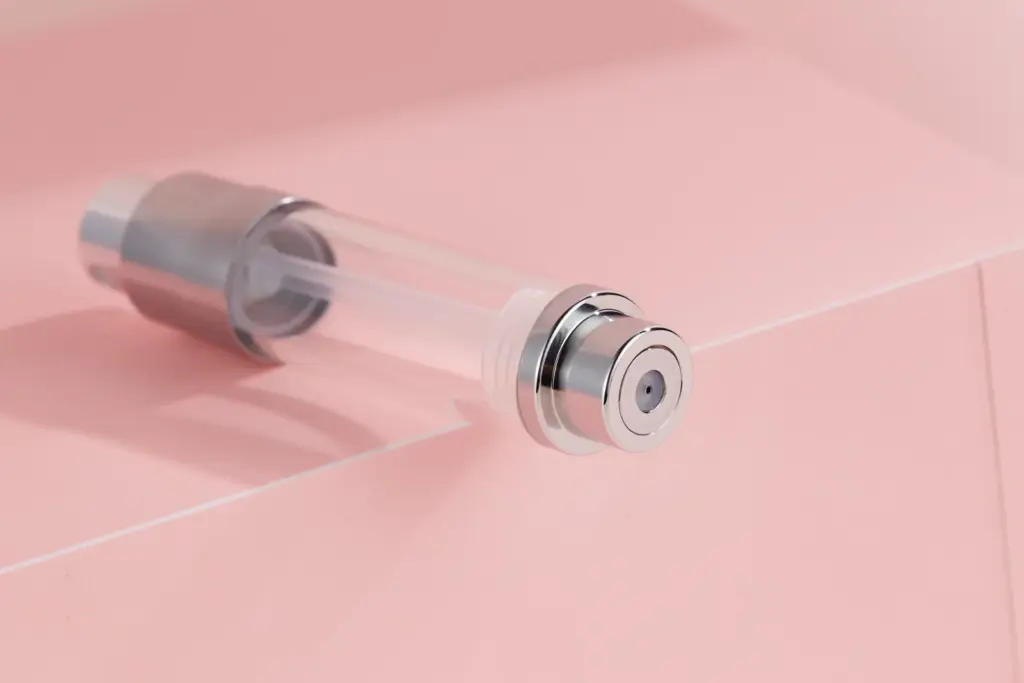
A bottom-fill perfume atomizer is a refillable travel spray that fills through a valve in its base. Its performance depends on the fit between the refill valve and the perfume bottle’s stem, the design and condition of its sealing system, and the compatibility of its fragrance-contact materials. No single dimension or material label guarantees reliable performance across every bottle and formula.
Explore GOOD TEC bottom-fill perfume atomizers →
Compatibility: Will It Fit Your Perfume Bottle?
How the bottom-fill valve works
On a compatible perfume bottle, remove the spray actuator—the button you press to spray—to expose the pump stem. Align the atomizer’s base valve with that stem, keep both upright, and press gently to transfer fragrance. Follow the instructions for your selected model; some designs require removing the inner vial from its housing first.
Why stem diameter and exposed height matter
The stem must fit the refill opening and extend far enough to engage the valve. Its shape, the surrounding bottle collar and the valve’s insertion depth also affect the connection.
Do not treat a 2.5–4.0 mm stem diameter or a 4 mm exposed height as a universal compatibility rule. These measurements need to be checked against the specific atomizer’s requirements. A perfume brand name alone is insufficient because pump designs can differ between products and bottle sizes.
How to measure your perfume nozzle before buying
- Check whether the spray actuator can be removed without force. Do not pull apart a sealed assembly.
- Remove the actuator and photograph the exposed stem and surrounding collar.
- Use a suitable caliper to measure the stem’s outer diameter without squeezing it.
- Measure the exposed height above the collar. Record the dimensions and bottle size.
- Send the measurements and photos to the atomizer supplier, then confirm the connection with a sample.
Which bottles need an alternative filling method?
Splash bottles and rollerballs do not provide the pump stem needed for this filling method. Bottles with fixed actuators, recessed stems or unusually shaped stems may also be incompatible. If the connection will not seat gently, stop rather than forcing it. Ask about a suitable top-fill model or an approved adapter.
Sealing and Leak Prevention: What Actually Matters?
Why a bottom-fill atomizer can leak
Leaks can originate at the base valve, pump connection or inner vial. Poor component fit, damaged seals, contamination and material degradation can all affect the liquid barrier. Changes in temperature and external pressure can also challenge a filled package.
A “leak-proof” claim is meaningful only when it is supported by defined test conditions. Ask which formula, fill level, storage orientation, temperature and test duration were used.
Seal quality is more than a material name
Silicone is one possible seal material, but its formulation, dimensions and interaction with the fragrance matter. “Food-grade” describes a particular suitability claim; it does not by itself establish compatibility with a perfume containing alcohol and fragrance oils. Request model-specific material information and filled-package testing.
Practical steps to reduce leakage risk
- Follow the fill limit. Leave the headspace specified by the manufacturer. A fixed 10–15% air gap is not a universal guarantee against leakage.
- Check after refilling. Wipe the exterior dry, replace the protective cap and inspect for moisture before packing.
- Protect the assembled atomizer. A fitted housing and cap can reduce accidental actuation and handling damage; they do not replace a sound seal.
- Test before a trip. Check the filled atomizer in different orientations according to its instructions. Use a separate pouch as additional luggage protection.
Materials: Glass vs. Plastic Inner Containers
PCTG and PP plastic inserts
Plastic inner containers can offer low weight and impact resistance. However, PCTG and PP are different polymers, and performance also depends on the resin grade, component design and fragrance formula. Neither should be accepted or rejected solely because it is “plastic.”
Ask the supplier to evaluate the intended formulation for changes such as swelling, stress cracking, discoloration, odor transfer and weight loss. Eastman’s material publications illustrate why chemical resistance is considered at the material and application level; they do not certify every plastic atomizer or perfume combination.
Glass inner containers
Glass is a useful option for fragrance-contact packaging when paired with a suitable pump and sealing system. Confirm the actual glass type rather than assuming every glass vial is borosilicate. A protective housing can help reduce damage during handling.
Glass does not make the assembled atomizer evaporation-free or preserve a fragrance indefinitely. The pump, seals, storage temperature and light exposure still matter.
What an aluminum outer shell can do
An opaque aluminum shell can shield the covered part of an inner vial from direct light and provide mechanical protection. Anodizing provides a surface finish; it is not thermal insulation. Keep the atomizer away from direct sunlight and hot environments, including a parked car.
Quick Buyer’s Guide
| What to check | Evidence to request | Why it matters |
|---|---|---|
| Refill interface | Supported stem dimensions and a sample fit check | Avoids relying on “universal fit” claims |
| Valve and seals | Material details and repeat-refill test results | Helps assess sealing after use |
| Inner container | Actual glass type or polymer grade | Supports formula compatibility evaluation |
| Travel performance | Defined orientation, temperature and pressure tests | Gives context to leakage claims |
| Housing and cap | Protection of the vial, pump and refill interface | Reduces handling and actuation risks |
Frequently Asked Questions
Can I clean a bottom-fill atomizer to switch fragrances?
Follow the cleaning instructions for the specific model. Do not assume that flushing with rubbing alcohol or water is suitable for every valve, seal and vial. Residual water or fragrance can affect the next fill, and some assemblies cannot be thoroughly dried. A dedicated atomizer or replaceable inner vial for each fragrance is often the more practical choice.
Can I take a perfume atomizer on an airplane?
For U.S. TSA checkpoints, carry-on liquids generally must be in containers of 3.4 oz (100 mL) or less and fit in one quart-sized liquids bag per passenger. A 5 mL atomizer is within that container-size limit, but it still counts toward your liquids allowance. Check the current TSA liquids rule and the requirements for your departure and connecting airports. Meeting a liquid-size rule does not certify an atomizer against leakage.
Does a glass inner vial guarantee that an atomizer will not leak?
No. The vial, base valve, pump and seals work together. Check the assembled model with your intended fragrance, not just the inner container material.
What should a fragrance brand send when requesting samples?
Include your preferred model, target capacity, bottle stem measurements, bottle photos, fragrance type, estimated quantity and desired finish. Confirm the refill connection and evaluate filled samples before approving a bulk order.
