
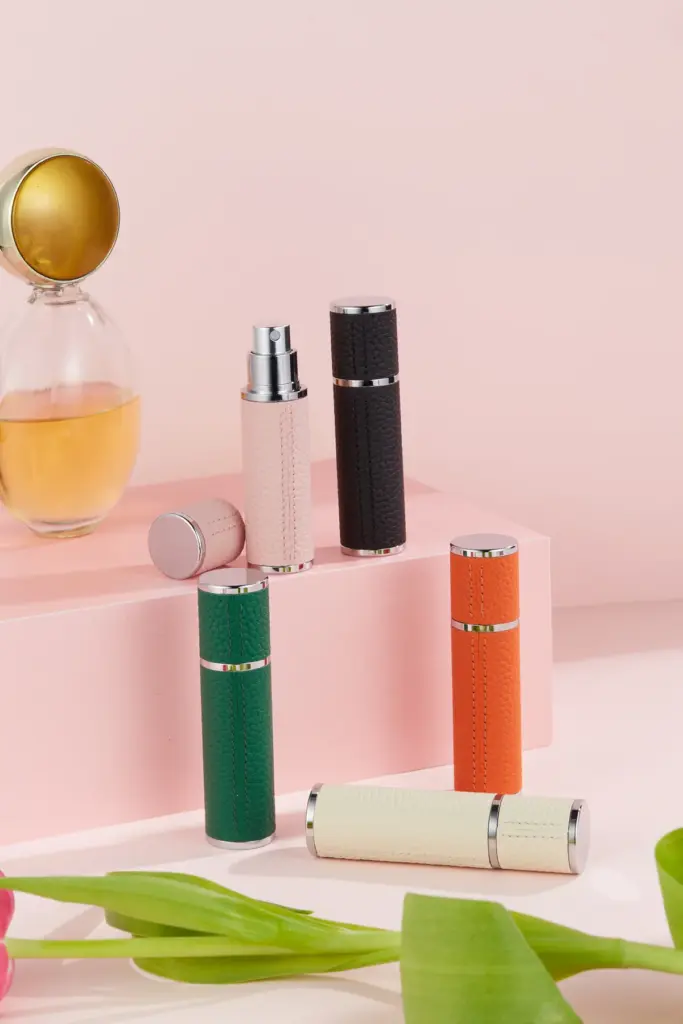
Choosing between bottom-fill vs top-fill perfume atomizers starts with one practical question: how will the customer refill the product? The right design depends on the source bottle, the filling workflow and the experience your fragrance brand wants to offer.
Bottom-fill atomizers transfer fragrance through a valve in the base. Top-fill atomizers provide access from above, often through a removable pump or an opening specified by the model. Neither format is automatically compatible with every perfume bottle, and neither format alone guarantees a leak-free package.
Bottom-Fill vs Top-Fill Perfume Atomizers at a Glance
| Buying question | Bottom-fill | Top-fill |
|---|---|---|
| How is fragrance transferred? | Through a base valve connected to a compatible pump stem | Through the model’s upper filling opening |
| What must be checked? | Stem dimensions, valve engagement and surrounding collar clearance | Opening, pump removal instructions and suitable transfer method |
| What should customers receive? | Clear bottle compatibility and refill instructions | Clear filling, reassembly and fill-limit instructions |
| What determines sealing? | Vial, pump, base valve and seals working together | Vial, pump, closure interface and seals working together |
When Bottom-Fill Makes Sense
A bottom-fill format is worth reviewing when the intended source bottle has an accessible, removable spray actuator and a compatible pump stem. The customer connects the refill valve directly to that stem, following the instructions for the selected atomizer.
For a brand selling a refillable travel accessory alongside a known fragrance bottle, this creates a clear sampling task: test the exact bottle and atomizer combination. Record the bottle size and pump version as well as stem dimensions. A connection that works with one bottle in a fragrance range should not be assumed to work with every size.
Start with GOOD TEC bottom-fill perfume atomizers, then request the refill-interface requirements for your selected model. For more detail, read our guide to bottle fit, seals and inner materials.
When Top-Fill Is Worth Reviewing
A top-fill option may suit a project where the source package does not expose a compatible spray stem, or where the intended filling process uses access from above. Ask the supplier to identify the opening, how the pump or closure is removed, and which transfer method is intended.
Do not assume that every top-fill design can be poured into, cleaned in the same way or opened repeatedly without affecting its closure. Review the actual assembly and its instructions. If an accessory is needed for transfer, include that accessory in the customer-use test and in the quoted packing scope.
Compare the Whole Refill Experience
Use the same evaluation brief for both formats. Give representative users the packaging and draft instructions, then observe where they hesitate. Can they identify the filling point, avoid overfilling and reassemble the package correctly? Are instructions readable at the size supplied with the product?
Record spills, refill time, accidental actuation and any difficulty opening or closing the assembly. These observations are more useful than choosing a format solely because it appears convenient in a demonstration. Consider the needs of a discovery set, a travel accessory and a branded gift separately.
Check Sealing and Formula Compatibility
For bottom-fill vs top-fill perfume atomizers, evaluate filled samples with the intended fragrance and agreed conditions. Include the vial, pump and every liquid-contact seal in the review. A glass inner container does not establish the performance of the complete assembly.
Ask for the actual material specification, the fill limit and the recommended storage conditions. Define how repeated filling, different orientations and handling will be assessed. Confirm what constitutes a failure, including visible moisture, loss of function or changes in appearance. Keep approved samples and written records of changes.
What to Include in a Supplier Inquiry
- Target capacity, product reference and intended use.
- Source-bottle photos and available pump-stem measurements.
- Intended fragrance and who will perform the filling.
- Preferred material, color, decoration and protective cap.
- Estimated quantity, sales destination and launch date.
- Required sample checks, instructions and packing format.
Ask the supplier to separate product development, tooling, samples, decoration and packing in the quotation where applicable. Compare proposals against the same requirements so that a lower unit price does not hide a different scope.
Which Format Should Your Brand Choose?
Choose after a sample review of the intended filling process and bottle combination. Bottom-fill can be a suitable direction when the refill connection is confirmed. Top-fill deserves consideration when access from above better matches the source bottle or workflow. The decision should follow evidence from your project.
Explore custom fragrance packaging development or send GOOD TEC your atomizer brief to review the next sampling step.
Planning direct-to-customer orders? Review our fragrance packaging checklist for e-commerce shipping alongside the refill design.
